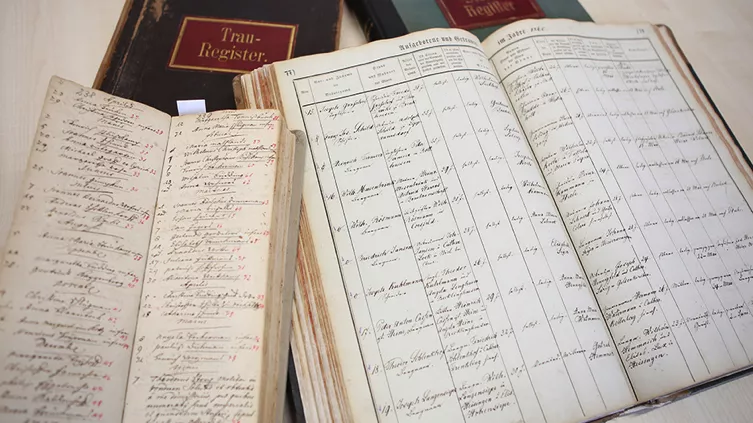
Church records were the main source of vital information in Brazil before 1889, documenting baptisms, marriages, and burials. Civil records, introduced nationwide in 1889, are standardized legal documents covering birth, marriage, and death. While civil records are more consistent and reliable for legal purposes, church records often contain richer family details and are essential for researching earlier generations. Understanding both is key to accurate genealogical research in Brazil.
What Are Church Records in Brazil and How Do They Work?
Church records were the primary system of record-keeping before civil registration.
What they include:
- Baptisms (similar to birth records)
- Marriages
- Burials
How they work:
- Created by Catholic parishes
- Often handwritten in Portuguese or Latin
- May include:
- Parents’ names
- Godparents
- Witnesses
Why they matter:
- They are often the only available records before 1889
- They can reveal extended family relationships
Use case: Essential for tracing ancestry into the 18th and 19th centuries.
What Are Civil Records in Brazil and How Do They Work?
Civil records are official government documents introduced after the separation of Church and State.
What they include:
- Birth certificates
- Marriage certificates
- Death certificates
How they work:
- Issued by civil registry offices (cartórios)
- Follow standardized formats
- Typically include:
- Full names
- Dates and locations
- Parents’ information
Why they matter:
- Legally recognized documents
- More consistent and easier to interpret
Use case: Required for legal processes like citizenship or inheritance.
What Is the Main Difference Between Civil and Church Records?
The key difference lies in purpose, structure, and reliability.
Comparison:
Church Records
- Older (pre-1889)
- Less standardized
- Rich in contextual details
- May vary by parish
Civil Records
- More recent (post-1889)
- Standardized format
- Legally valid
- More consistent across regions
Simple explanation:
Church records tell stories; civil records confirm facts.
Which Records Are More Reliable for Genealogy?
Both are reliable—but in different ways.
Civil records:
- More accurate for:
- Dates
- Legal identification
- Lower risk of interpretation errors
Church records:
- More informative for:
- Family relationships
- Social context
- May contain additional clues not found elsewhere
Practical example:
A baptism record may include godparents (often relatives),
while a birth certificate confirms legal parentage.
Best approach: Use both together.
When Should You Use Church Records Instead of Civil Records?
Use church records when researching earlier generations.
Situations:
- Ancestors born before 1889
- Missing civil records
- Rural or less documented regions
Why:
Civil registration did not exist yet, so:
- Churches were the only institutions recording life events
Important: Many genealogies in Brazil depend entirely on church archives for early periods.
When Are Civil Records More Useful?
Civil records are essential for modern and legal research.
Situations:
- Research after 1889
- Citizenship applications
- Legal identification of individuals
Why:
They provide:
- Standardized information
- Legal validity
- Easier access and interpretation
Benefit: Faster and more precise identification.
What Are the Main Challenges of Each Type of Record?
Church records challenges:
- Difficult handwriting
- Language variations (Latin/Portuguese)
- Inconsistent formats
Civil records challenges:
- Limited historical depth
- Access restrictions in some cases
How to handle:
- Cross-check multiple sources
- Learn basic record interpretation
- Use contextual clues (names, locations, relationships)
Key principle: No single record is enough—combine sources.
How Do Civil and Church Records Work Together?
The most effective genealogy research uses both.
How they complement each other:
- Church records → extend lineage backward
- Civil records → confirm identity forward
Example:
- Baptism record identifies parents
- Marriage record confirms family structure
- Death record validates timeline
Together, they create a complete and reliable family history.
Mini FAQ
Which came first: church or civil records in Brazil?
Church records came first and were the main source before 1889.
Are church records legally valid in Brazil?
They are historically valuable but usually not valid for legal purposes today.
Why are civil records more standardized?
Because they are issued by government offices following national regulations.
Can I do genealogy in Brazil without church records?
Only for recent generations. Earlier research depends heavily on them.
Who should use both types of records?
Anyone doing serious genealogical research, especially across multiple generations.
Conclusion
Civil and church records in Brazil serve different but complementary roles. Civil records provide legal certainty and consistency, while church records offer depth and historical reach. Understanding how to use both is essential for accurate and complete genealogy.
If you are researching Brazilian ancestry—especially across generations—combining these sources or working with a specialist can significantly improve your results.
Updated in: June/2026